
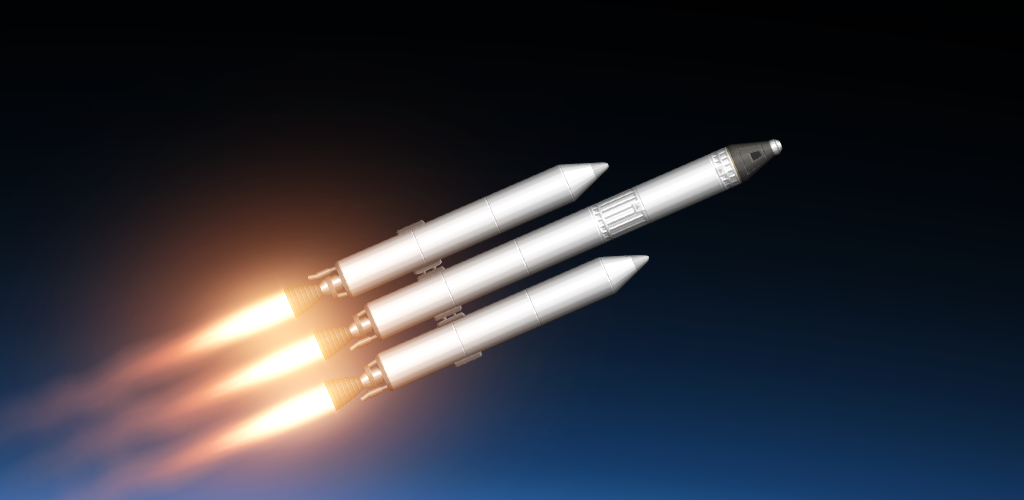
Spaceflight Simulator turns a blank launch pad into a puzzle: pick the parts, light the engine, and find out whether your rocket flies or folds. We wanted that loop without an install, so we built Apogee Works, an original 3D rocket game that runs right here on this page. You choose engines, tanks, boosters and fins under a budget, launch, steer a gravity turn, drop your spent stages, and try for orbit. It is free, needs no signup, and a new Daily contract arrives every day.
Play Apogee Works now
Tap Launch to fly the prefilled rocket, or change a part first. Best played with sound on.
How to play
Every contract gives you a target altitude, a payload weight, a wind speed and a budget. Pick an engine and tank for each stage, add boosters or fins if you want them, then launch. On a keyboard, A and D tilt the rocket, W and S move the throttle, Space drops the stage, F switches on prograde hold (the rocket follows its own path), and T speeds up time while you coast. On touch, use the arrow buttons, the throttle slider and the Stage, Prograde and warp buttons.
Climb mode starts easy and gets harder with each cleared level. The Daily contract is the same for everyone on a given date, so you can compare notes. Your best scores, your level and your daily streak are saved on your device, and nothing leaves your browser.
How it compares to Spaceflight Simulator
Apogee Works keeps what makes a rocket sandbox work: you build the machine, you fly it, and physics decides whether you were right. Gravity weakens with height, thick air drags on the frame, a rocket aimed sideways too early tears itself apart, and a stage that runs dry is dead weight until you drop it. Reaching orbit means going sideways fast enough that the ground curves away, not just going up.
What we left out is the freedom. Our builder offers a handful of engines, three tank sizes, boosters and fins, so you cannot design a rocket part by part. There is one small planet, no Moon, no docking, no map view and no transfer planning. A full orbit here takes about two minutes, where the original lets you spend a whole evening on one mission. We also render in 3D with a chase camera, while the original is a flat 2D sandbox.
If a contract here makes you curious about longer missions, the real game is the next step. It gives you a much larger parts catalog and other worlds to reach. Keep this tab open when you want a quick, scored launch.
Get the full game
Spaceflight Simulator is a 2D rocket-building sandbox for Android where you assemble a rocket, launch it and fly it on real orbital physics. The game is free to install, with optional paid extras. If you want more space games after this one, we compared seven in our best space simulation games for Android roundup. Players who like the sandbox angle may also want our list of Ellipse: Rocket Pioneer alternatives, and our best space exploration games for Android covers the travel side of the genre.
Frequently asked questions
Can I play Spaceflight Simulator in a browser?
The official game is an app you install from a store, so it is not a browser game. Apogee Works, the game on this page, is our own original rocket game built to run entirely in the browser on desktop or phone. It captures the build, launch and stage loop, not the full sandbox.
Is this the real Spaceflight Simulator?
No. Apogee Works is an original game we built, inspired by the rocket-building genre that Spaceflight Simulator belongs to. It is not affiliated with, endorsed by, or connected to the developer or publisher of Spaceflight Simulator. All art, physics and sound are our own code, and the download links above go to the official app listings.
How do you reach orbit in Apogee Works?
Climb vertically for a few hundred meters, tilt toward the right a little, then switch on prograde hold so the rocket bends into a gravity turn. Cut the engine when the apogee reading shows about 5,000 meters and coast. At the top, point sideways and burn until your lowest point clears the atmosphere. Orbit pays a 600 point bonus, and you need a bigger build than the default rocket to get there.
How is the Daily contract chosen?
The target altitude, payload weight and wind are all generated from the current date, so every player gets the same contract on the same day. Clear it and your streak goes up by one. The streak and your best scores are stored in your browser’s local storage.
Is it free, and does it work offline?
Completely free, with no ads, purchases or accounts. Once the page has loaded, Apogee Works makes no further network requests, so it keeps running if your connection drops. Nothing you do in the game is sent anywhere.


